A map is only as useful as its criteria are clear. The thinking behind categories, criteria, and how to get listed.
State of the Graph is vendor-neutral by design. That neutrality is not a stance or a marketing claim. It is the product. The moment the map reflects commercial relationships rather than technical reality, it stops being useful to the people who rely on it: practitioners choosing tools, analysts tracking market structure, enterprises evaluating platforms, and vendors trying to understand where they stand in a crowded ecosystem.
This post explains how the map is built, how tools get added, how edge cases are handled, and how the catalog stays current. If you build a tool that belongs on the map and it is not there yet, the path to registration is at the end.
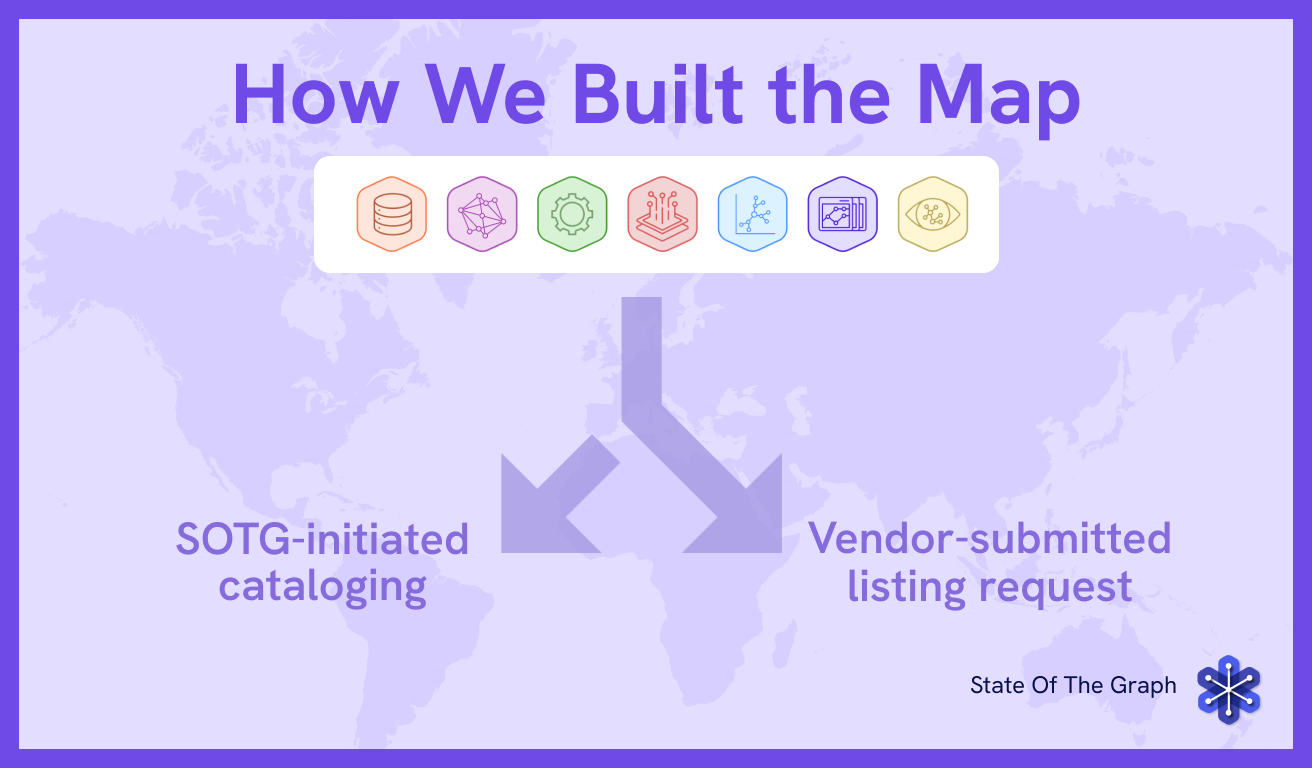
Two paths onto the map
Every tool in the State of the Graph catalog arrived through one of two routes.
State of the Graph-initiated cataloging. The team identifies tools independently through market research, community signals, conference programs, analyst coverage, and practitioner conversations. Tools are evaluated against the published criteria for each category and added when they qualify. Vendors are not contacted for approval before listing.
Vendor-submitted listing request. Vendors can submit their product directly via the Listing Request Form at stateofthegraph.com/get-listed. Submissions are reviewed against the same criteria applied to State of the Graph-initiated entries. Meeting the criteria is what determines inclusion. Submitting does not guarantee it.
Both paths produce the same outcome: inclusion is based on what a tool does, not on who submitted it or whether any commercial relationship exists.
The criteria
Each of the seven categories has its own eligibility criteria, published and applied consistently. Every criterion is designed to answer one question: does this tool genuinely belong here?
Defining what the categories of graph technology are and the criteria for each one of them has been a key part of our work. It is as hard as it is necessary.
We understand that there will always be mixed reactions about category definitions. Some people will appreciate this, others not so much. The point is that you can’t have a catalog without categories, and you can’t have categories without criteria. The full criteria for all seven categories are listed in each category with its corresponding category page.
Graph Databases
Graph database systems store and query data as graphs, treating nodes and relationships as first-class citizens. The State of the Graph database catalog offers a single access point for browsing, comparing, and choosing the offering that is right for your needs.
Knowledge Graphs
A knowledge graph is a graph‑structured representation of entities and their relationships, expressed in a machine‑readable way and enriched with semantics so that applications can interpret and reason over the connected data.
Graph Analytics
Graph Analytics tools use graph queries and algorithms to uncover patterns, relationships, and actionable insights from connected data. The State of the Graph offers a single access point for browsing, comparing, and selecting graph analytics tools that match your needs.
Graph Engines
Graph engines run graph computation over data stored in other systems, projecting nodes and relationships on the fly instead of requiring you to move everything into a standalone graph database.
Graph Visualization
Graph Visualization tools render graph data visually, helping users explore connections and navigate complexity. This catalog brings together tools whose primary purpose is interactive graph and network visualization, spanning analyst-oriented platforms and apps, classic desktop workbenches, and developer-focused libraries and SDKs that act as building blocks for custom graph experiences.
Graph Application Development
Graph application development tools sit above graph platforms, giving teams practical environments to build, operate, and use graph-powered applications. IDEs, no-code/low-code platforms, and ontology editors simplify the building, deployment, and management of graph-powered applications by turning graph models into workflows, consoles, and analytical workspaces that teams rely on day to day.
GraphAI
GraphAI describes systems in which graph structure plays an active role in AI reasoning, not just as infrastructure behind the AI but as a core mechanism shaping what is retrieved, remembered, or learned.
GraphAI extends classic graph machine learning by using graphs not only as training input (GNNs) but as live components in AI pipelines, where GraphRAG and Graph Memory shape inference, retrieval, and agent cognition in real time.
In this catalog, we organize offerings into three Graph AI types: GraphRAG, Graph Memory, and GNN (Graph Neural Networks)
A tool can qualify for more than one GraphAI subtype. It can also qualify for GraphAI alongside other categories on the map. Both are documented rather than resolved by picking one.
What we do, and what we do not do
The criteria define what gets in. These define what never happens, regardless of who asks.
No rankings. The catalog does not rank tools within categories. Tools that meet the criteria are listed. How they compare to each other is not something the map addresses, nor is it something State of the Graph will be drawn into.
No pay-to-list arrangements. Submitting a tool is free. Being listed is free. No commercial relationship with SOTG affects whether a tool is included or how it is presented.
No endorsements or recommendations. The map shows what exists. It does not tell users what to buy, which tool is best suited for a particular use case, or which vendors are worth talking to. Those judgments belong to the people making the decision.
No removals at a competitor’s request. A tool in the catalog stays there until it fails to meet the criteria on its own merits, not because another vendor in the category has raised a concern.

The reason this matters is straightforward: trust. And trust depends on the criteria being applied consistently, every time.
The vendors who use the map to understand their competitive landscape need to trust that every tool in their category is there on merit. The analysts who cite the map need to know the coverage is comprehensive, not curated by marketing spend. The practitioners who use it to choose tools need to know it is complete.
The hard cases
Clean criteria do not eliminate judgment calls. These are the situations the SOTG team encounters most often and how they are handled.
A tool qualifies for more than one category. Both. Multi-category listing is not an exception; it is the correct answer when a tool genuinely meets the criteria for more than one category. 20 of the 128 products in the current catalog appear in multiple categories.
The overlap is documented rather than hidden, because it reflects real architectural relationships between categories. A graph database with a full GraphRAG layer belongs in both Graph Databases and GraphAI. Resolving that by picking one would make the map less accurate, not more organized.
A tool is evolving rapidly and may qualify soon. Not yet. The criteria are applied to what a tool does today, not what it has announced. If a product is in private preview or beta, or has a roadmap feature that meets a criterion, it is noted as being evaluated and added when the capability becomes generally available.
A tool in the catalog is repositioning itself. Category changes only when capabilities change. Vendor messaging does not trigger recategorization. If a graph database starts calling itself a knowledge graph platform without adding the capabilities that the Knowledge Graphs criteria require, it remains a graph database. If it adds those capabilities, it moves. The map tracks what tools do, not how they describe themselves.
A tool in the catalog is no longer maintained. It is moved to the legacy or deprecated section of the relevant catalog. The State of the Graph catalog documents the full picture of the ecosystem, including tools that shaped the market but are no longer actively developed.
Legacy tools remain visible because they are part of the historical record and many are still in production use. They are clearly marked to distinguish them from active offerings.
A submitted tool does not clearly meet the criteria. It is not added. The vendor may be contacted with a note on which criteria were not met, so they can resubmit if and when the product evolves. The criteria are published precisely so vendors can evaluate fit before submitting rather than after the fact.
How the map stays current
The catalog is a living reference. Three things trigger a change.
A new tool is identified. Via State of the Graph research, community signals, or vendor registration. Evaluated against the criteria for the relevant category. Added if it qualifies.
An existing tool changes. A tool adds capabilities that qualify it for a new category, loses capabilities and no longer meets the criteria for an existing one, or is acquired by another vendor. An acquisition updates the vendor record but does not trigger recategorization unless the capabilities themselves change.
A tool is deprecated. Moved to the legacy section of the relevant catalog. Not removed entirely. The historical record stays intact.
GraphAI is currently the highest-velocity category on the map, given the pace of new entrants and capability announcements. Other categories are updated as the catalog evolves. Significant additions and changes are announced via the State of the Graph mailing list and on LinkedIn.
How to get listed
The State of the Graph catalog is open and free. If you have a graph technology product or project that meets the criteria for a category, the process is straightforward.
- Find the category where your product belongs. In some cases more than one category may apply.
- Review the criteria for that category above.
- Fill out the Listing Request Form at stateofthegraph.com/get-listed if you believe your product meets the criteria. Use the message field to include links to publicly accessible information the State of the Graph team can use to verify your submission.
One thing worth knowing before you submit: each category distinguishes between products that are actively developed and used and those that are legacy, deprecated, or early stage. The State of the Graph team will let you know where your product lands.
Questions about which category your product belongs in, or whether it meets the criteria? The criteria above are the starting point. If something is genuinely ambiguous, that is worth raising: it may signal that a category definition needs to evolve, or that your product sits at an interesting boundary between continents.
We are open to people’s ideas and suggestions, and we may eventually revise our categories and criteria as the technology and the market evolve. Please refer to our Listing Request Form, Code of Conduct, Terms and Conditions and Privacy Policy before reaching out.
The map is the product. The criteria are what make it trustworthy. Both are public, both are applied consistently, and both will evolve as the ecosystem does.
Explore the full catalog at stateofthegraph.com/categories.
Join the mailing list for catalog updates and new posts: stateofthegraph.com

Leave a Reply