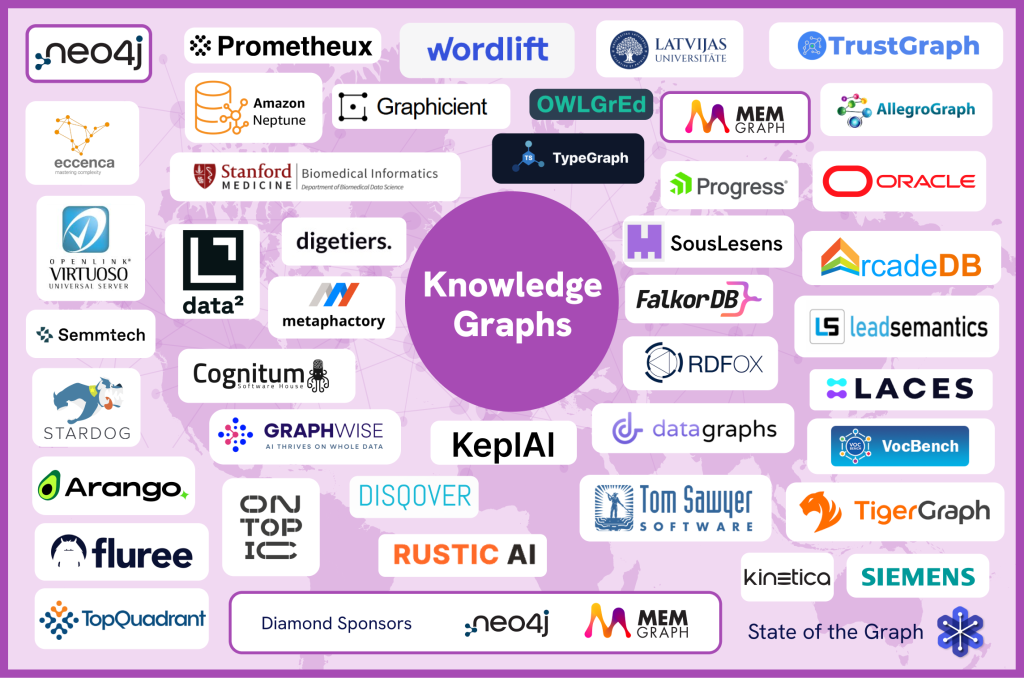
Knowledge Graphs
A knowledge graph is a graph-structured representation of entities and their relationships, expressed in a machine-readable format and enriched with semantics so applications can interpret and reason over connected data.
The Knowledge Graphs catalog covers two product types:
- Knowledge graph platforms build, store, and query the graph.
- Ontology and schema modeling tools define the graph’s structure: the classes, relationships, and rules it follows.
Each type has its own criteria. A product needs to qualify for at least one type, not both. Some products qualify as both and ship a knowledge graph platform and a modeler as one product.
All products appear in one table, and the Platform Type column shows each product’s type. Products that qualify as both carry both tags. Every offering must be positioned as a viable option for real-world knowledge graph deployments.
Our Sponsors
Memgraph
Diamond sponsor
Memgraph is a high-performance, in-memory graph database built for real-time AI context and graph analytics. It serves as the graph engine for GraphRAG pipelines, AI memory systems, and agentic workflows, delivering sub-millisecond multi-hop traversals with full provenance for systems that need structured, connected context alongside semantic search. The same architecture powers real-time graph analytics across fraud detection, network analysis, infrastructure monitoring, and other operational use cases.
Neo4j
Diamond sponsor
Neo4j is the knowledge layer for enterprise AI. Powered by the Neo4j Graph Intelligence Platform, Neo4j connects organizational data with humans and AI systems, surfacing not just relationships, but how and why they exist. The result is AI that is accurate, explainable, and governable. Built to integrate with everything. Proven by 84 of the Fortune 100 and supported by the world’s largest graph community, Neo4j helps organizations move AI from pilot to production.
Knowledge graph platforms
To be included, a knowledge graph platform must meet all three of the following criteria:
- Expose a knowledge graph model: Represent entities and relationships as a first‑class graph model (property graph, RDF, or other) for a specific domain.
- Enable KG creation: Provide mechanisms to ingest, construct, and update the graph from multiple sources.
- Support KG querying: Provide a query language to access and update that graph for multi‑hop and knowledge‑centric use cases.
It must also provide at least 2 of the 4 following capabilities:
- Semantic & Metadata Capabilities such as metadata management, ontologies, inferencing, semantic data fabric, lineage, and harmonization.
- User Experience & Usability, including visualization, KG exploration, low‑code tools, collaboration, and curation workflows.
- GenAI Support, such as GraphRAG, embeddings, vector search, and agentic AI integration, with those AI features tightly coupled to the KG.
- Trust & Explainability, including provenance, lineage, schema governance, audit trails, fact grounding, hallucination mitigation, compliance, and uncertainty.
Ontology and schema modeling tools
The category also features Ontology & Schema Modeling tools that operate on top of existing graph stores and tools for designing and maintaining semantic structures – schemas, SHACL shapes, taxonomies – that power knowledge graphs.
To be included, an ontology and schema modeling tool must meet all three of the following criteria:
- Define the schema of a knowledge graph: Model a domain’s classes, properties, relationships, and constraints as a reusable schema for a knowledge graph, in a standard semantic model (OWL, RDFS, SKOS, SHACL) or a first-class property graph schema.
- Support the ontology lifecycle: Provide editing, versioning or governance, and validation or reasoning, built to maintain a model over time, not to draw one-off diagrams.
- Connect to the knowledge graph: Publish to, sync with, or validate data in a knowledge graph platform or graph store, or export in standard formats that knowledge graph platforms load as their schema.
Both types: Capabilities count only when generally available. Experimental, preview, or beta features do not.
The table compares these offerings across platform type, modeling style, query languages, KG construction and real-time operation, advanced graph and performance capabilities, semantic features, user experience, enterprise search, GenAI and trust features, and GenAI maturity.
The goal is to let users quickly see how each product approaches knowledge graphs and how they compare.
Tech Professionals | Analysts and Investors | Vendors and Builders
Please note: You need to create an account in order to access this content.
The table summarizes these tools across key dimensions so you can quickly see where each product fits and which merit a deeper look.