Knowledge Graphs
A knowledge graph is a graph‑structured representation of entities and their relationships, expressed in a machine‑readable way and enriched with semantics so that applications can interpret and reason over the connected data.
To be included in this Knowledge Graphs catalog, an offering must meet all of the following criteria and be positioned as a viable option for real‑world knowledge graph deployments. It should:
- Expose a knowledge graph model: Represent entities and relationships as a first‑class graph model (property graph, RDF, or other) for a specific domain.
- Enable KG creation: Provide mechanisms to ingest, construct, and update that graph from different sources.
- Support KG querying: Provide a query language to access and update that graph for multi‑hop and knowledge‑centric use cases.
In addition, a knowledge graph offering must also provide at least 2 of the 4 following capabilities:
- Semantic & Metadata Capabilities such as metadata management, ontologies, inferencing, semantic data fabric, lineage, and harmonization.
- User Experience & Usability, including visualization, KG exploration, low‑code tools, collaboration, and curation workflows.
- GenAI Support, such as GraphRAG, embeddings, vector search, and agentic AI integration, with those AI features tightly coupled to the KG.
- Trust & Explainability, including provenance, lineage, schema governance, audit trails, fact grounding, hallucination mitigation, compliance, and uncertainty.
The table summarizes these offerings across platform type, modeling style, query languages, KG construction and real‑time operation, advanced graph and performance capabilities, semantic features, user experience, enterprise search, GenAI and trust features, and GenAI maturity.
The goal is enable users to quickly see how each product approaches knowledge graphs and which are worth deeper evaluation.
Tech Professionals | Analysts and Investors | Vendors and Builders
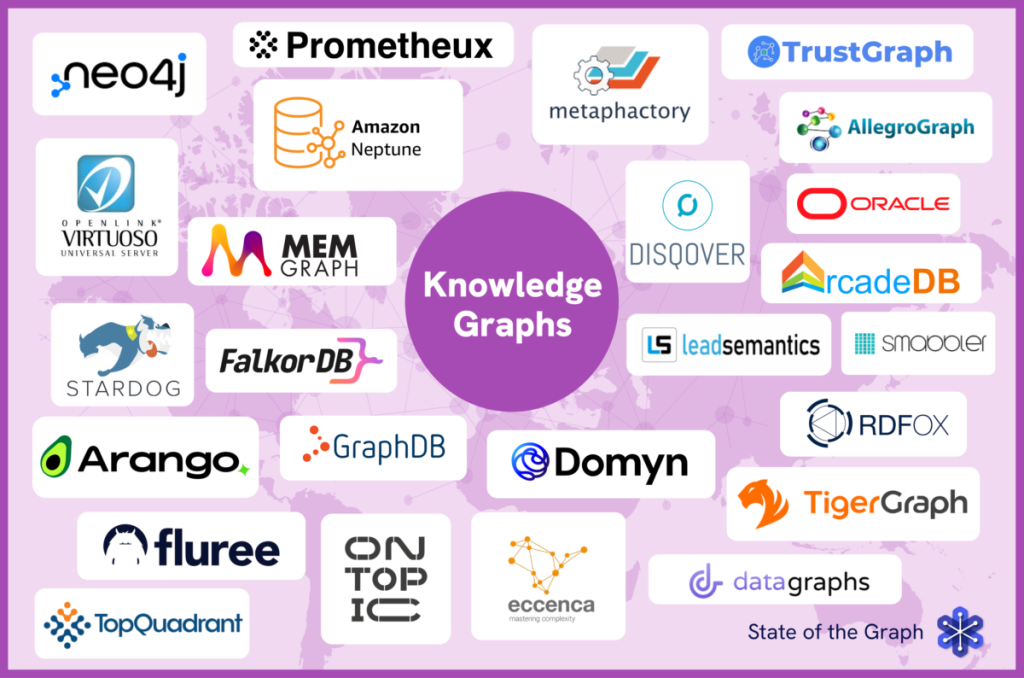
Please note: You need to create an account in order to access this content