Graph Databases
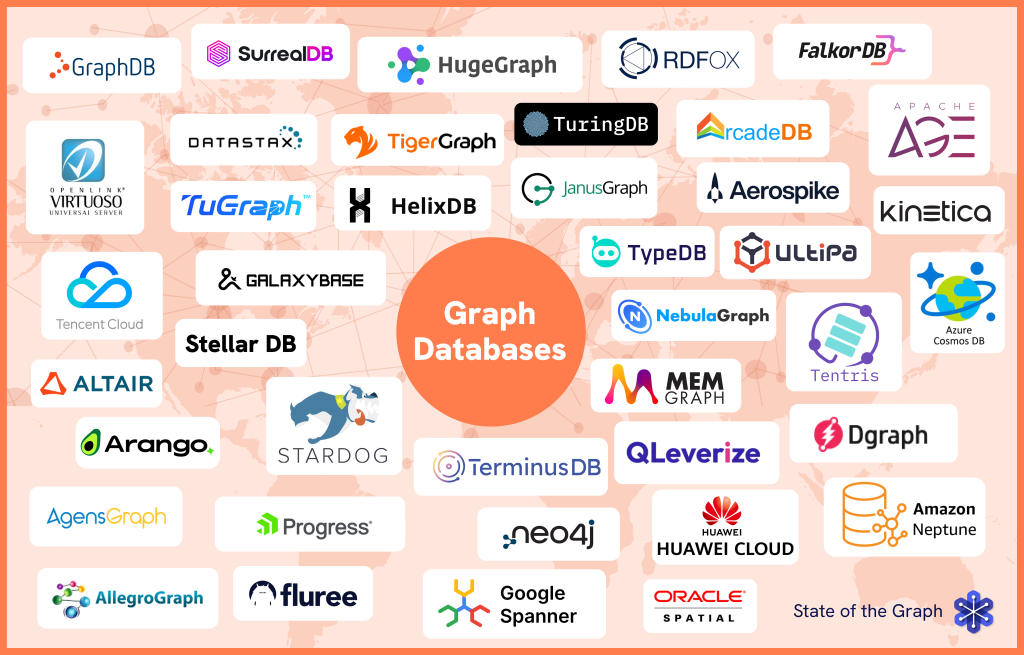
Graph database systems store and query data as graphs, treating nodes and relationships as first-class citizens. The State of the Graph database catalog offers a single access point for browsing, comparing, and choosing the offering that is right for your needs.
We split our graph database catalog into two groups in this sheet: the main table lists current, mainstream graph databases, while a later section labeled “Legacy, niche, and graph-adjacent databases (extended list)” captures older, more specialized, or graph-adjacent offerings for completeness.
To be included, an offering has to meet three criteria:
- First-class graph model: It exposes a clear property graph or RDF model, with nodes (vertices) and edges (relationships) as core structures, and full support for CRUD (Create, Read, Update, Delete) operations via a graph API / query language.
- First-class graph querying: It supports graph-aware query languages or APIs (for example, Cypher, SPARQL, Gremlin, GQL, or an equivalent), not just ad-hoc joins or custom code on non-graph storage.
- Deployable product: It has a clear deployment path as open source or commercial, self-managed, managed in the customer’s cloud, or SaaS, suitable for real-world use rather than only experiments.
The table summarizes these products across key dimensions such as graph model, storage and distribution, workload focus, transactions, scalability and high availability, query languages, tooling and ecosystem, availability and deployment options, marketplace presence, and product status, so you can quickly see where each one fits and which are worth deeper evaluation.
Tech Professionals | Analysts and Investors | Vendors and Builders
Please note: You need to create an account in order to access this content